Most budgets fail not because people lack discipline, but because they lack a system. You sit down in January, write out some spending categories, assign some numbers, and feel great about it. Then February happens. Life gets busy, a few unexpected expenses show up, and by March the budget is a distant memory.
The problem is not willpower. The problem is that most budgeting methods are reactive. You track what you already spent and hope the numbers look okay. Envelope budgeting flips that around entirely.
The Original Envelope Method
The idea is simple, and it predates spreadsheets by decades. You take your paycheck in cash, divide it into physical envelopes labeled "Groceries," "Rent," "Gas," "Entertainment," and so on. When the grocery envelope is empty, grocery shopping stops until next month. No math required. No spreadsheet. The envelope is the limit.
It works because it makes the abstract concrete. Money in a bank account is just a number. Money in a labeled envelope is real and finite. You feel it when you spend it.
The core insight of envelope budgeting: spending decisions should happen before you spend, not after. When you reach into an envelope and it feels thin, you make a different choice.
The downside of the physical method is obvious. Carrying envelopes of cash everywhere is inconvenient, a little risky, and honestly a bit awkward at the checkout counter. So the idea needs to live somewhere digital without losing what makes it powerful.
Zero-Based Budgeting: Every Dollar Has a Job
Envelope budgeting pairs naturally with zero-based budgeting, which takes the system one step further. The idea is straightforward: at the start of every month, you assign every single dollar of income to an envelope until you reach zero. Not zero in your account, zero in your unassigned pile. Every dollar has a purpose before the month begins.
This is different from how most people think about budgeting. The typical approach is to pay bills, spend on the usual stuff, and hope something is left over to save. Zero-based budgeting treats savings as just another envelope. You decide in advance how much goes to groceries, how much goes to dining out, how much goes to your emergency fund, and how much goes to that vacation you have been putting off. Then you stick to it.
The result is that you are never surprised by where your money went. You already knew, because you decided.
How Envelop Brings This to Life
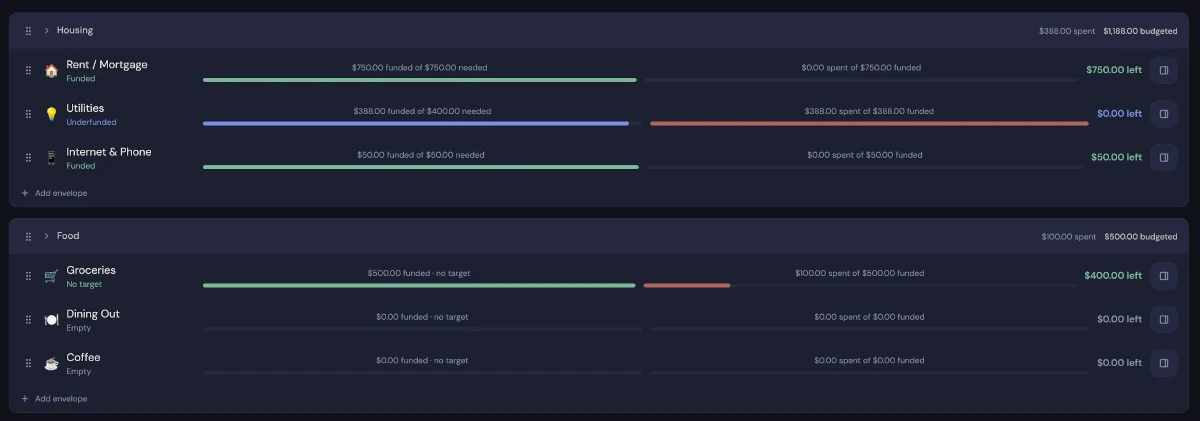
Envelop is built around this exact system. When you get paid, you add your income and it shows up as money ready to be assigned. You allocate it across your envelopes until every dollar has a home. Then, as you spend, you record transactions and assign them to the right envelope. The envelope balance goes down in real time.
You always know exactly how much is left in each envelope and how much is left to allocate overall. There are no hidden surprises at the end of the month, just a clear, honest picture of where things stand.
Intentional by design
One deliberate choice in Envelop is that transactions are entered manually. There is no automatic bank import syncing your purchases in the background. That might sound like a limitation, but it is actually a feature.
When you manually enter a transaction, you are making a conscious choice to acknowledge it. You know you just spent $47 on dinner. You open Envelop, enter it, and watch your dining envelope adjust. That small act of recording keeps you connected to your spending in a way that automatic syncing never quite achieves. It takes about ten seconds, and those ten seconds matter.
Budgeting works best when it is an active habit, not a passive report you glance at once a month. Manual entry keeps you in the driver's seat.
Why This System Actually Sticks
The reason envelope budgeting has survived for generations, and why zero-based budgeting has become popular with everyone from personal finance beginners to large corporations, comes down to a few things.
- Clarity. You always know where you stand. Not roughly, exactly.
- Intention. You decide where money goes before it has a chance to disappear into the void.
- Accountability. When you record every purchase, you stay honest with yourself.
- Flexibility. Had an expensive month for car repairs? Move money from another envelope. The system bends without breaking.
It is not about being restrictive. It is about being intentional. There is a real difference between spending $200 on dining out because you chose to allocate it there and spending $200 because you lost track. One feels good. The other does not.
Getting Started
The hardest part of envelope budgeting is the first month. You are guessing at numbers you have never tracked before, and some envelopes will be wrong. That is fine. The second month is better, and the third month starts to feel natural.
The goal is not a perfect budget. The goal is a budget you actually use. One that reflects real life, adapts when things change, and gives you confidence that your money is working the way you want it to.
That is what Envelop is built to do. Give every dollar a job, know where every dollar went, and make budgeting something you actually look forward to checking in on rather than something you avoid.
Ready to give every dollar a job?
Envelop is free to try for 14 days, no credit card required. Set up your first budget in minutes and see how it feels to know exactly where your money is going.
Start your free trial